In this chapter we examine the reciprocal nature of an axis and the relationship between its opposing signs. We then explore the first of the six axes—the Aries/Libra axis—through the Tale of Linda Fierce: Linda, who embodies the essence of Libra, James, who embodies the essence of Aries, and their relationship, evocative of the Axis of Grace.
A Prelude to the Six Axes
Six spokes extend around the Zodiac, each one representing one of the six axes. These include:
| Aries/Libra | The Axis of Grace |
| Taurus/Scorpio | The Axis of Resilience |
| Gemini/Sagittarius | The Axis of Knowledge |
| Cancer/Capricorn | The Axis of Stewardship |
| Leo/Aquarius | The Axis of Greatness |
| Virgo/Pisces | The Axis of Devotion |
Each of these axes represents an expression of the fire-to-air relationship of elemental intelligence. Aries balances Libra and Libra balances Aries. These two signs are reciprocal in nature: Aries at its best is decisive; Libra at its worst is indecisive. Libra at its best is considerate; Aries at its worst is inconsiderate. The positive expression of Aries defines negative Libra and the positive expression of Libra defines negative Aries. Aries and Libra are sides of the same archetypal coin. One can’t exist without the other any more than the north pole of a magnet can exist without the south pole.
When Aries is imbalanced, the need arises for Libra: rudeness invites politeness. When Libra is imbalanced, the need arises for Aries: fragility invites strength. When both are expressing in a positive way, they attract one another, activating the axis between them. A synergy emerges from their integration as the quality of grace.
Positive Aries and Positive Libra give rise to the Axis of Grace.
Grace cannot be faked and it cannot be manufactured. It arises organically when the highest expressions of Aries and Libra align, in any context. It might be an individual, a couple, or even an institution. Whenever Aries and Libra integrate, grace emerges. The same principle applies to the other five axes.
Signs in opposition also complement each other, activating their axis in a unique way when they align. We refer to this emergent quality as the alchemical transformation of the axis—“alchemical” because it is a qualitative shift that arises at the level of consciousness. Understanding the six axes, we grasp one dimension of the fundamental qualities that uphold the mind.
Now, we can let go of these concepts and simply enjoy the Tale of Linda Fierce. The story brings the Axis of Grace to life without the need for explanation. After each story, we present a Commentary section to further develop the ideas it contains.
The Tale of Linda Fierce
At twelve, Linda felt the weight of a stranger’s stare in the bustling market while her mother haggled over the price of fish. She dismissed it, but the following week the gaze returned—at a diner, where another man sat alone at a table behind her laughing parents, his eyes fixed on her.
No longer the frail, golden-haired girl who raced gulls along the shore, Linda was teetering on the edge of womanhood. Her changing appearance was already reshaping the world around her. One night, as she lay in bed, she overheard her parents talking in the living room, assuming she was asleep.
“She’s got looks from nowhere, Beth. Doesn’t take after either of us,” her father said, his voice heavy with unease. “I see how men watch her.”
“Our girl’s turning heads, Mike,” her mother replied.
His tone sobered. “Every gift is also a curse. Beauty’s no exception.”
Beth scoffed. “She’ll be envied by half the world and desired by the other half. What’s the curse in that?”
Linda lay still, her mind turning over her mother’s words, unease curling in her chest. That summer she stayed with her grandmother, an herbalist who lived in a small cottage surrounded by a vast garden of healing herbs. Gran made potions and lotions she sold at the Sunday market. One afternoon, while foraging for mushrooms together, Linda told her about the conversation she had overheard. Gran stopped, looked her in the eyes, and gently stroked her hair.
“You are becoming a very beautiful woman, Linda. You must match that beauty with wisdom, or the power blossoming in you will become the source of your unhappiness.”
Linda didn’t quite understand the advice, but she never forgot the words.
By sixteen, boys at school stumbled over themselves in her presence, as if her beauty cast a spell they couldn’t break. Some grew loud and brash, others flushed bright red, and a few avoided her entirely, eyes darting away. The girls were no better—sidling up with syrupy smiles and hollow compliments about her dress or hair. Their flattery was a thin veil for envy; each one hoping to bask in the glow of the school’s prettiest girl.
Her first crush was a shy boy named James. He had raven-black hair and eyes like smoldering coals, a sensitive soul with a quiet artistic side. He made her feel strangely uneasy. In response, she avoided him, secretly hoping he would approach her while carefully keeping the widest possible distance whenever they were in the same room.
One day he slipped her a sketch he had made of her. It captured a hidden softness she often felt in private but never allowed herself to show publicly. Her heart melted. She showed the drawing to her best friend, Mary Jane.
“It doesn’t even look like you. Just another loser with a crush on you,” Mary Jane scoffed. She snatched the drawing from Linda’s hands and ripped it up with theatrical flair, right in front of their classmates—including James—then tossed the shreds into the waste bin and laughed.

That night Linda hugged her pillow and cried. The next morning she resolved to fall in love with a more suitable partner. James never spoke to her again, and she buried her feelings for him, turning her attention instead to Jake Carlson, the handsome and charming captain of the football team.
She made eye contact with Jake and smiled, knowing her face was a lure no sane boy could resist. He smiled back, flashing his white teeth in a gregarious grin that acknowledged her as the queen of the school. They began dating, to no one’s surprise. Linda played the role of the devoted girlfriend, happily sharing intimate details with her friends about how much Jake loved her.
Around the time of her seventeenth birthday, he took her to a fancy restaurant to celebrate. Feeling grown-up and a little tipsy from the wine they had drunk beforehand, she was stirred by the romantic atmosphere. Later that evening, in the back seat of his car in a remote parking lot beside a woodland preserve, she let him have her. As he pushed into her in the cramped space, his garlic-scented moans shattered the moment. She was relieved when he finally finished and drove her home.
The next day at school, she recounted the evening to Mary Jane, embellishing every detail into a romantic fairy tale. She carefully hid the truth: the mere thought of Jake now brought to mind garlic breath and made her nauseous.
She put up with him until graduation, feigning love, feeling trapped but unable to find a way out. Then providence arrived in an unexpected way when Mary Jane called her in a panic. “I just saw him holding hands with someone else.”
Linda confronted Jake. She felt only relief when he admitted he had fallen in love with a college girl. They parted as friends, neither heartbroken, since neither had truly been in love.
In college, Linda attracted as much attention as she had in high school. She dated a select few from a steady lineup of charming, muscular suitors drawn to her beauty. While she appreciated the attention, she also developed a quiet contempt for the opposite sex. She saw men as weak and easily manipulated—shallow creatures who mistook surges of hormones for love. She went through a phase of discarding them quickly, growing tired the moment she sensed they were disingenuous pretenders putting on an act to impress her.
One day in the park, Linda watched with deep fascination as a plain-looking couple frolicked in the grass. The woman had a crooked smile, the man balding with a rumpled shirt, yet they touched each other with such genuine tenderness and kindness that there was no trace of pretense or posturing. Though neither was beautiful on their own, together they were. Observing their simple, pure love gave Linda a profound sense of satisfaction.
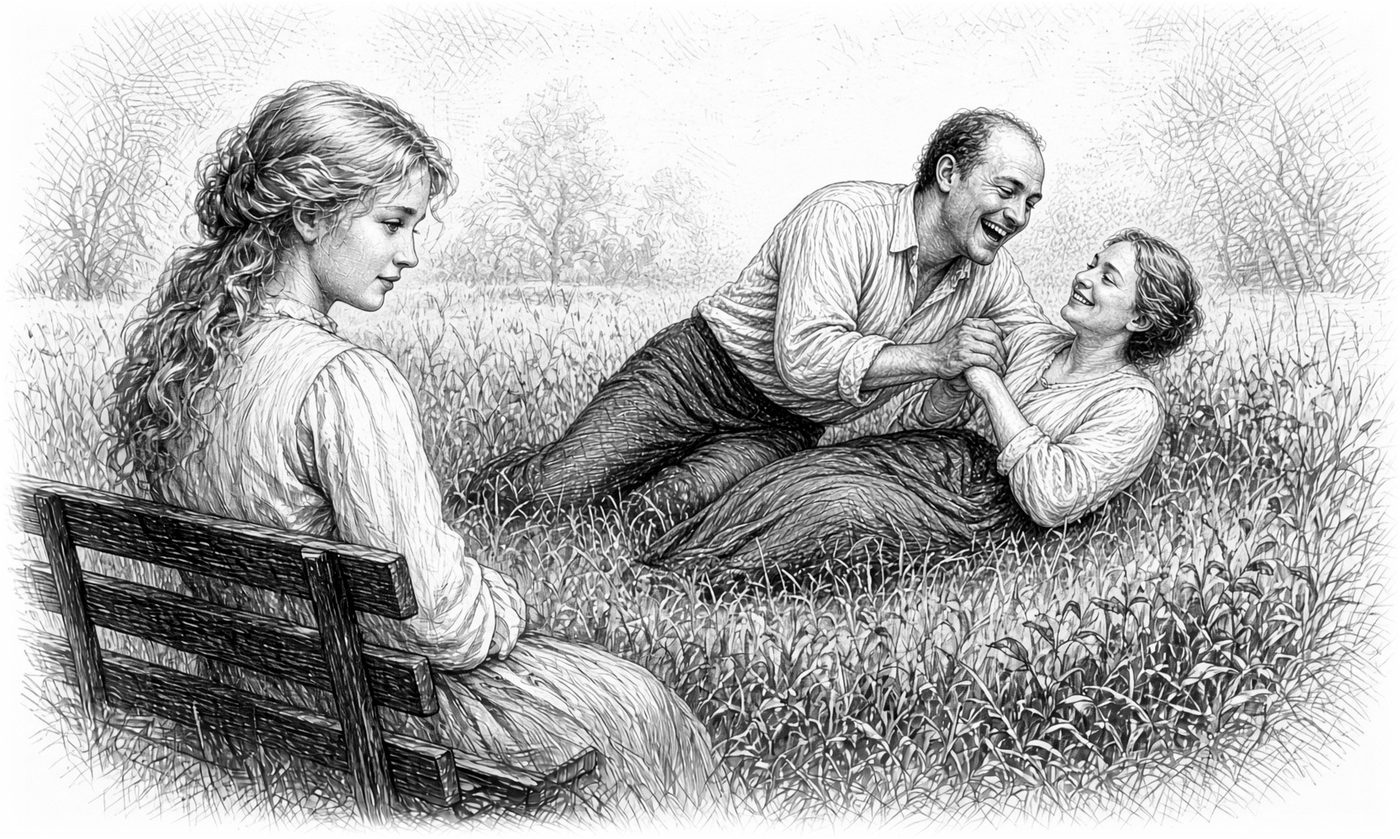
That evening, lying in bed and reflecting on the couple, she wondered if the real problem had been her own selectivity—always chasing the most handsome men. This unadorned yet whole couple unshackled something inside her. No longer would she hunt for flawless faces. Instead, she would seek the man who stirred her soul, whose touch carried that same quiet harmony. With a vow whispered into the darkness, Linda felt truly free—ready at last for a love that burned true.
Linda cast her net wide, a quiet ache trailing behind her. She dated the short, the stout, the silver-haired—each offering a flicker of wit or charm, but none kindled the soul-deep connection she craved. At twenty-eight, weary of hollow sparks, she swore off love’s distractions. No more half-measures. No more mirages.
With a sharp-eyed plan, she took a job at a sleek men’s boutique where wealth draped in fine wool walked through the doors daily. Her manager praised the soaring sales; Linda prized the steady parade of men, each one measured for a suit and, perhaps, a chance at her heart. She studied them—the cut of a jaw, the cadence of a voice—searching for the one whose love would echo the harmony she so deeply yearned for.
One day, a man entered the boutique. Black-rimmed glasses framed a philosopher’s gaze, fine lines etching his face as he spoke. His name was Louis LeGrand. He returned the next day and bought five suits with effortless charm. His Parisian accent drew easy laughter from her.
“Parlez-vous Français?” he asked. When she spoke a few broken phrases, he teased her, took her soft hands and recited a poem, its rhythm like a velvet breeze.
“It’s beautiful, but what does it mean?” she asked. He only smiled and slipped out.
The following morning, roses arrived, their fragrance flooding the store. Linda’s heart lifted as she held the note, scrawled with “Louis LeGrand” in elegant French she couldn’t read. Her manager translated it: a limousine would be waiting for her the next evening, promising an unforgettable night, sworn with noble intent.
Linda glowed, swept up in the romance.
Nine months later, Linda married Louis on his yacht, the Aegean ablaze with sunset. The captain blessed their vows before a small gathering of friends. Draped in silk and enamored by the opulence of her new life, Linda believed she had finally found love.
Linda became the mother of two children. Her heart swelled with motherhood. She glided through glittering soirées in chic gowns, surrounded by chauffeurs and chefs in a gilded existence. But Louis slowly drifted away, his warmth fading over the passing years.
Late one evening he entered her bedroom without knocking, his face shadowed. “Linda, they filed a damned lawsuit,” he said, voice hollow. “Grave charges. Everything changes.”
His mistress had turned informant and unraveled his web of fraud and bribery. Convicted, Louis lost both his fortune and his freedom. Reeling from the shame and betrayal, Linda fled back to the States with her children, her spirit fractured.
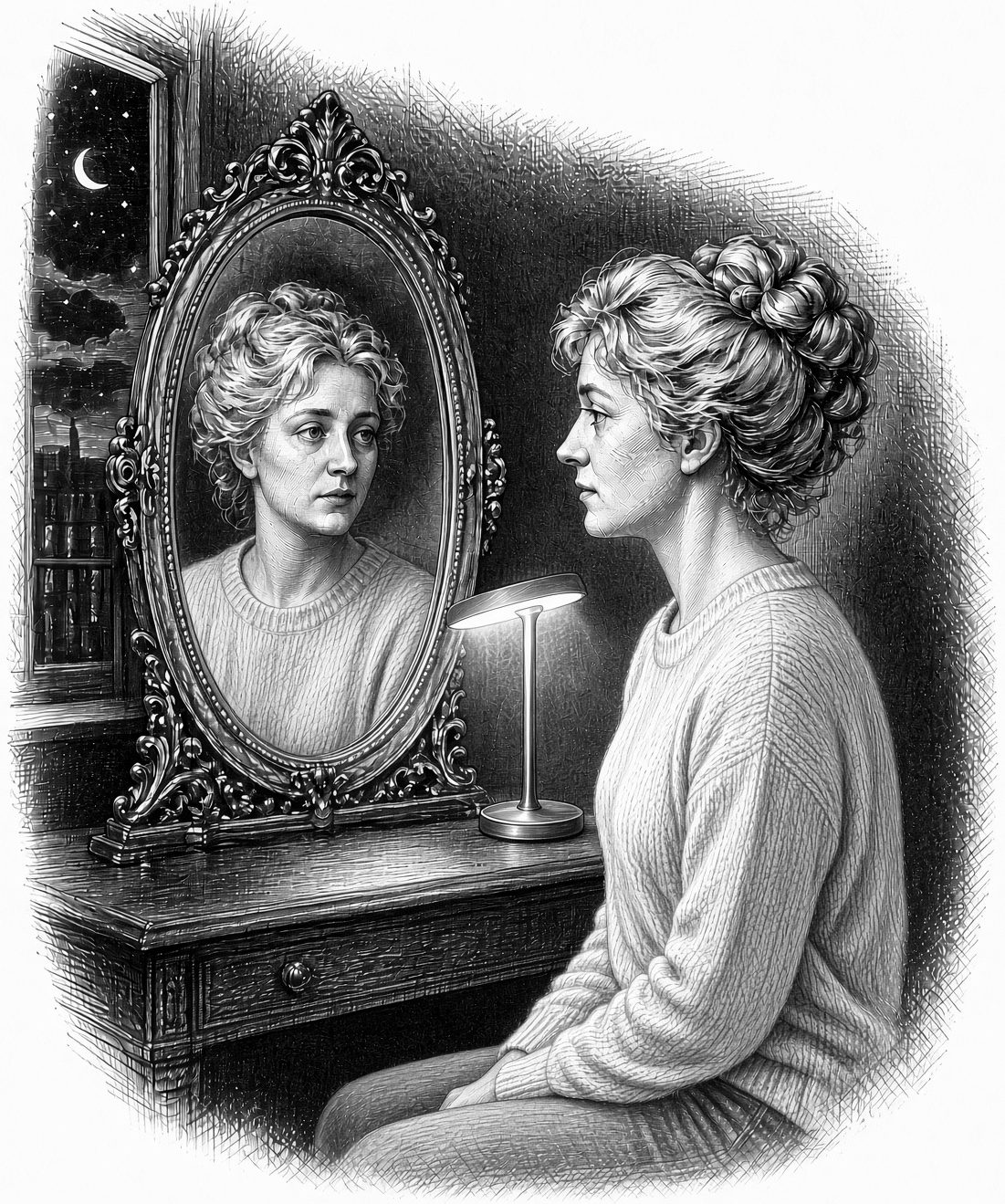
One night, staring into the mirror, she whispered bitterly, “Who’s the ugliest now?” Her reflection stared back like a stranger—her once-radiant beauty dimmed.
On the day of her forty-fifth birthday, Gran passed away. Adrift in despair, Linda’s spirit flickered. A few nights later, as she tossed in a restless sea of sleep, Gran’s spirit appeared. She smiled gently and whispered tender words of love.
At dawn, a spark of resolve kindled within her. With her savings and Gran’s old recipes, she launched a bold venture: Inner Beauty, a line of herbal potions and lotions drawn from her grandmother’s wisdom. Three years of tireless work shaped the dream. Friends began whispering its name, and when a magazine published a glowing review, sales soared.
For five years Linda burned with entrepreneurial fire. She built a strong team and opened her own showroom. Pride glowed within her, yet in quiet moments a soft ache of loneliness remained—her heart still yearning for love’s true harmony.
Late one afternoon, weaving through the city hum on her way home from the office, Linda froze before a poster. Bold letters blazed across it: The Triumphal Art of James Fierce, Gallery Savoy.
Those coal-dark, piercing eyes in the photo were unmistakably James’s—the shy boy from high school whose sketch had once captured her hidden softness. Her heart quickened. She traced the date and time with a nervous flutter. Why this sudden pull, this tremor? she wondered. What ghosts might rise?
She tried to dismiss the urge, but some deeper force pulled her forward. She bought a new dress and lipstick, berating herself for her childish excitement as she paid.
“You’re a foolish woman,” she told her reflection as she applied the finishing touches. “But you’re still pretty.”
The gallery hummed with a lively crowd, members of the press among them, all drawn to the acclaimed artist James Fierce. His “Triumphalist” series blazed on the walls: a boy’s triumphant home-run swing, a sprinter ecstatically crossing the finish line, a powerlifter roaring as he heaved massive weight with explosive force—each face radiant with victory. Bold colors danced with sharp yet tender lines, pulsing with the raw energy of triumph.
Then Linda saw him, ringed by admirers. Their eyes met for a single heartbeat. Her pulse leaped. A wave of fear urged her to retreat, but a fiercer spark drove her forward. She stepped toward him, her heart trembling like a flame.
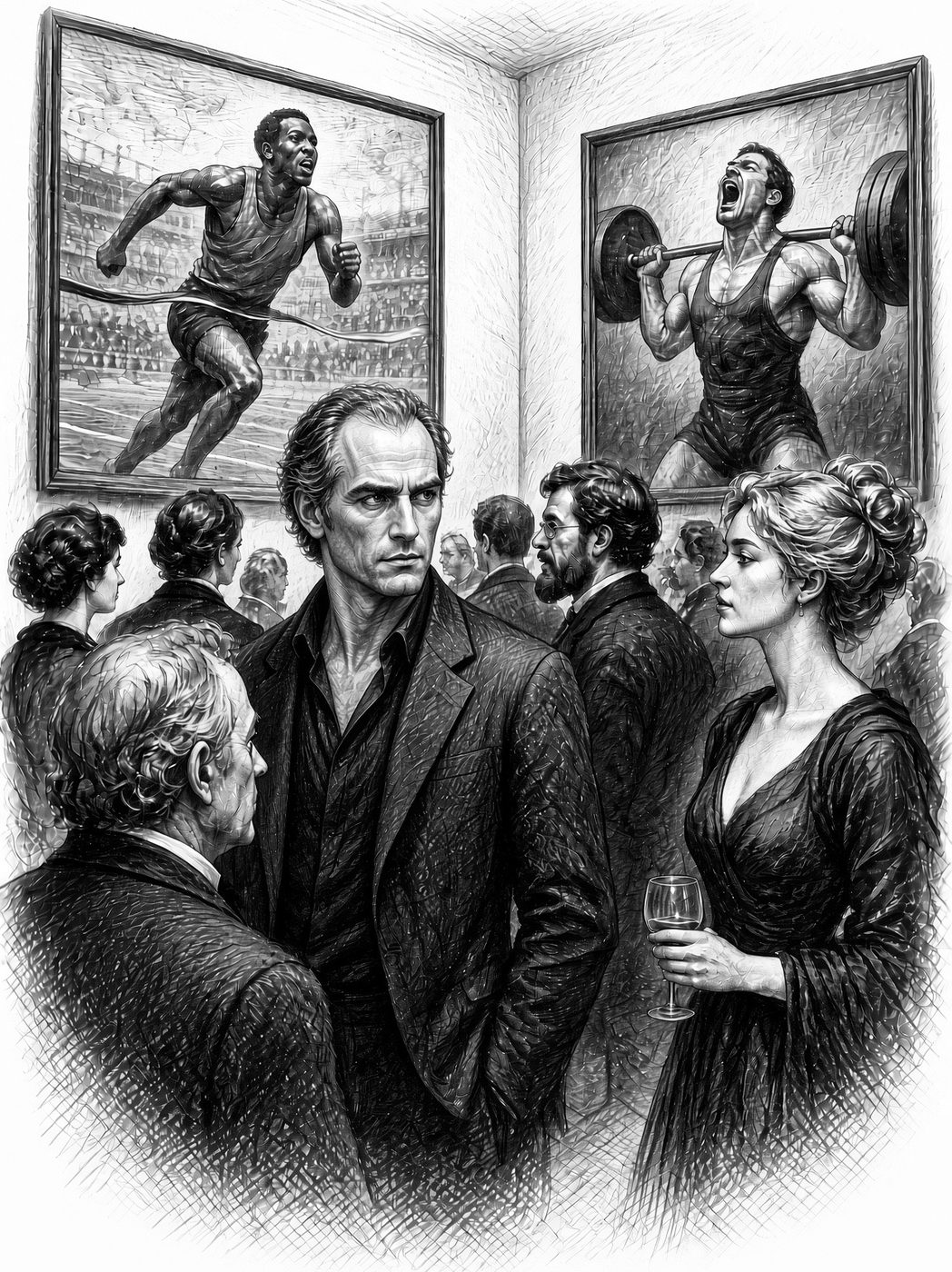
“I doubt you’d remember me,” she said. “We went to high school together.”
“I remember you,” James replied. “You ripped up the sketch I made of you.”
“It wasn’t me who ripped it,” Linda said quickly, “but I still owe you an apology.”
“Then apologize over dinner. Saturday?”
“Yes,” Linda blurted, before she could think better of it.
On the walk home, old tides of youth surged through her. Time stumbled backward. She chided herself for the schoolgirl flush, even tempted to cancel, yet a quiet force gently nudged her forward.
At dinner, wine in hand, she laughed softly. “I’ve changed so much.”
“Not to me,” James said, his gaze steady. “My artist’s eye still sees the same you—soft, beneath the shine.”
“You drew a softness only Gran ever glimpsed. I’m not sure it’s still there.”
“I saw the ache for love buried deep in your heart,” he replied. “Forgive my boldness… but it’s still there.”
Linda stilled. “I don’t know. Life has been harsh on my heart. What about you?”
“Do you want the uncensored truth?”
“I dare you,” Linda said coyly.
“Your rejection opened a wound. I was angry because I wanted you so badly. I had never felt like that before, or since. That darkness spilled into my art. And then into my marriage. My wife was a good woman. Decent and loving. I was inconsiderate. Then cruel. It began with words. One day it became physical, and she left me. She did the right thing.”
“Because of me?” Linda asked.
“Because of me. You opened my heart, but the darkness was already there. I chose what I did with it.”
“What happened next?”
“Poverty, followed by fame. Women—lots of them for a while. And a lot of drama. Eventually I walked away from all of it. I lived alone for years. Celibacy gave me some peace, but more than anything, I had to learn to live with myself. You?”
“Kind of the same,” Linda said. “But on the receiving end. Celibacy as well.”
“And here we are, back to the beginning.”
“I’d like to think a little wiser,” Linda added.
“I saw you in high school,” James said quietly. “Not your beauty—just you. That sketch was my confession. I was a scared little runt. You were nobility. I was no one. It took every ounce of courage I had to hand you that drawing. It was my heart.”
“I’ll sound foolish,” she said, “but… I had a crush on you too.”
“Courageous admission,” he smiled. “Why?”
“I was a pretty face everyone loved. You saw past my face. The softness in my heart. Your drawing touched me. That softness is still there.”
He raised his wine glass, “To my courage, your softness, and tomorrow.”
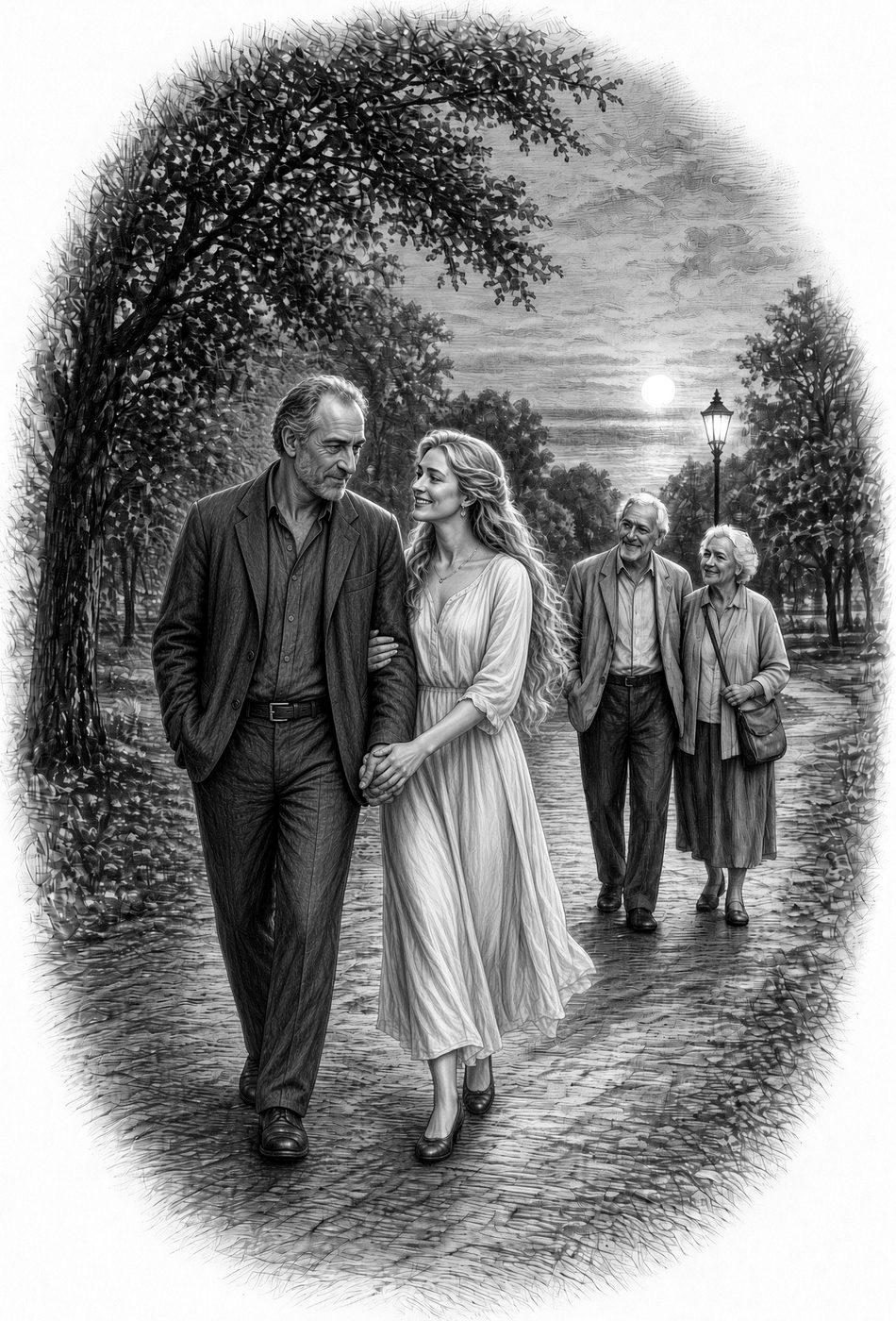
They clinked, smiling with innocent, heartfelt warmth. As they left the restaurant, James took her hand. She let it rest in his. The sensation felt odd, but not wrong. She did not pull away. She let him lead her toward the park, the fragrance of summer drifting through the evening. She had not chosen to walk.
For a moment, she felt the old thing—the sensation of being pulled by someone else’s certainty. She considered pulling away. But just then, he let her hand go. Linda looked at him, then grasped his hand gently and pulled him toward her. They walked silently, looking ahead, passing an old couple who watched them.
The white-haired woman whispered to her husband, “Such a graceful pair.”
Commentary: The Tale of Linda Fierce
This story is the Aries/Libra axis told through the relationship of Linda and James. Linda carries Libra: consideration, and its shadow of indecision. James carries Aries: the decisiveness to move first, and its shadow of inconsideration. The commentary that follows treats their meeting as the place those two virtues touch and awaken the Axis of Grace.
Aries
Imagine being a random teenager secretly in love with the most beautiful girl in the school. The odds of being noticed are infinitesimal. The risk of approaching her is sizable: you risk scorn and shame. This was James’s predicament, and yet he summoned the courage to jump over the shadow of fear and give Linda a drawing he made of her. Mary Jane, Linda’s friend, ripped it up in front of him. That was the cost, but he still made the gift.
The willingness to risk is the essence of Aries. When you are attracted to someone—when you want them—that willingness increases. Picture a young man in a gym, straining beneath a barbell’s crushing weight, arms trembling. From the corner of his eye he glimpses a young woman he likes. Her presence ignites his Aries fire, and he powers through three more reps, his heart a forge of grit and desire. James’s drawing was that extra rep.
Aries is the will to pursue what is wanted. It jumps over the line in the sand no one else dares to cross. It looks for those lines, summons courage and pushes onward. Fear is the base material that it converts to courage. Without it, the pretense of courage—bravado—is expressed, a mere shadow of its potential glow.
Had James chosen to back off at the last minute, the trajectory of his life would have changed. Linda would not have discovered his feelings for her. They would not have reconnected. While James’s attempt did not produce the results he wanted, he made an impression on her and bent the arc of destiny. Most boys would never dare, but he did and the story ends with the two holding hands.
The shadow of Aries manifested for James in the context of other relationships. Aries likes to win; James lost, at least in his youthful mind. The loss unleashed anger that he projected onto other women, including his wife, treating them unfairly. He was inconsiderate, emotionally abusive, his dark side culminating in violence.
The light of Aries is decisiveness; the shadow is being inconsiderate, unfair, and selfish.
Libra
Imagine being the prettiest girl at school. You are expected to date a certain type of guy. Along comes a boy who does not fit the part, yet he sees something in you that no one else does. He hands you a drawing he made. Clearly he likes you. The drawing reveals something deeper than his feelings. He sees an aspect of you that lies hidden behind your pretty face. His act of courage makes an impression.
Your best friend does not think so. She scoffs at the drawing and rips it up, and in the process rips at the deeper part of you. What is left is your face and the expectations of everyone shaping your life.
Linda is beautiful. While Aries pushes, Libra draws in. She is a magnet. The desire to be beautiful, to present well, to make a room or a life more harmonious—that is Libra. Power underlies it, a force no less powerful than Aries. Beautiful things elicit desire. Linda does.
Beauty is not a random construct. Its expression varies across cultures, but proportion is the secret underneath. Much of what we recognize as beautiful is held together through proportion. A rose is beautiful for the same reason as the Mona Lisa, Chartres, and the Andromeda Galaxy. Music reveals the same principle. A beautiful melody is a relationship of sounds in the right measure. Notes are ratios and music is their relationship. A face is fashioned the same way. Linda’s face holds because the proportions are harmonious, and that harmony draws the eye.
Harmony does not stop at objects. A relationship is harmony between people. Someone bumps you accidentally and they apologize. The same bump, but this time with rudeness, and conflict erupts. Politeness and kindness bring the room back into balance. Linda is good at this. She reads the air in the shop, at the table, on the boat. She keeps it even.
When the measure holds, trust follows: the willingness to stand unguarded with someone because you believe they will not use that opening against you. Trust is the foundation of a relationship.
Once in a relationship, consideration brings proportion and maintains harmony. When disagreements arise, both sides are considered, then a measured response. A compromise. That is the ground love needs. Love is what happens when beauty, kindness, and trust stay in relation long enough for two people to rest in each other.
The trouble starts when Linda will not choose what she wants. She liked James. The clique did not. She went along. Later she married the type of man she was supposed to marry. Indecision with Libra is not uncertainty or hesitation. It is knowing what one wants and lacking the will to choose it because of other people’s expectations. She keeps the appearance and leaves herself out of her decisions.
Repeat that long enough and the inner life flattens. What remains is manner: a pleasant surface, easy to like, hard to reach. Superficiality is the face disconnected from the soul. Libra becomes two-dimensional. Linda, once matured, understands that a relation with no self in it cannot hold love. She chooses celibacy over the pretense of love.
The light side of Libra is consideration. Its shadow is indecision—the choice that leaves the self out.
The Horizon Line
On the most common wheel of the Zodiac, Aries and Libra form the horizon line, the first axis. This one comes first because life springs from it.
Aries wants. Libra wants to be wanted. One pushes, the other pulls. Attraction is the fuel between them. Imagine stripping desire from a life. It stalls. Imagine stripping it from the species. Within two generations we would cease to exist.
Attraction, desire, sex, and love—these qualities are what keep people in relation and keep the species alive. In youth we feel the drive in our own bodies. Later we watch it move through our children. Without the courage to claim what we want, without the capacity for harmonious relations, the horizon of life dims. That is why this axis comes first.
The Axis of Grace
Aries and Libra define the axis they form. Their light and shadow complement each other. The light of Aries, turned over, is the shadow of Libra. The shadow of Aries, turned over, is the light of Libra.
Aries at its best is decisive. Libra at its worst is indecisive—not because it cannot choose, but because it will not. Linda liked James. The circle around her did not. Peer pressure twisted her will. She laughed when they laughed, let the moment pass, and called it being reasonable.
The light of Libra is consideration. The shadow of Aries is inconsideration.
James’s selfish streak played out in the relationships that followed. He was unfair. At the far end of that streak came violence.
The reciprocal relationship between the two signs can be depicted as follows:
| Aries | decisive / inconsiderate |
| Libra | considerate / indecisive |
Signs that share an axis are defined by antonyms, words that imply an opposition. The one hundred and eighty degrees separating Aries and Libra reflects that opposition. The same pattern applies to the other five axes. The light of any sign defines the shadow of the sign it opposes. Any antonym pair will do. Libra is selfless; Aries is selfish. Aries is rude; Libra is polite.
The Aries–Libra opposition mirrors a Möbius strip: a loop twisted once and joined. A journey along its surface returns you to the origin, inverted. Trace Aries’ decisive fire, twist it, and it emerges as Libra’s indecision. Follow Libra’s moderation, loop it back, and it becomes Aries’ reckless haste. The twist shows their unity. One’s light twisted becomes the other’s shadow; one’s shadow twisted is the other’s light.
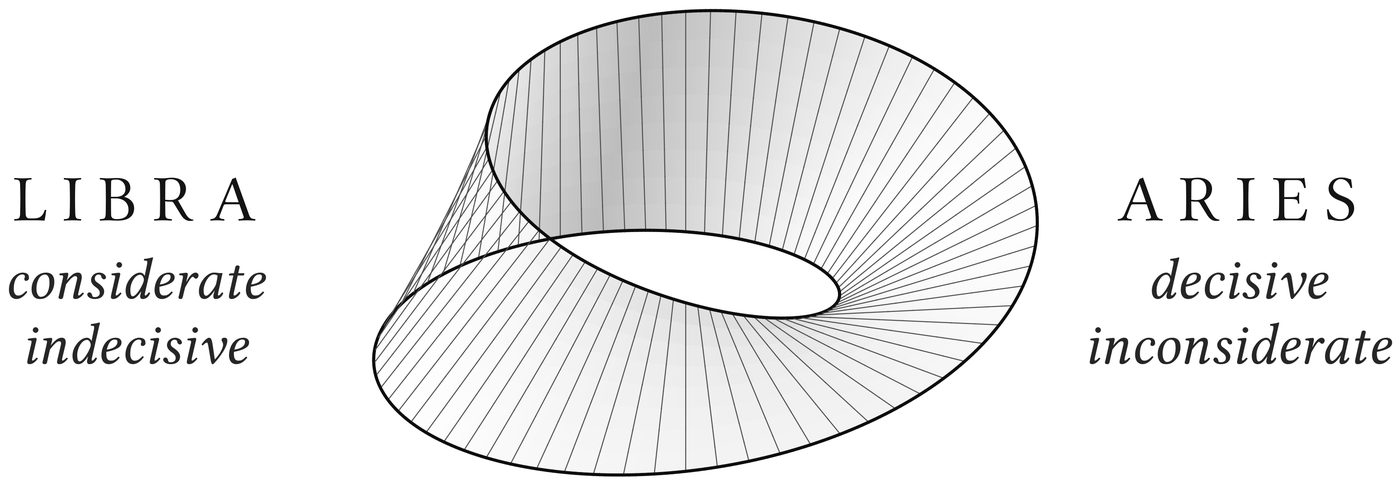
The axis comes alive when the light of Aries and the light of Libra are both awake. Strength and beauty, courage and love, boldness and kindness—the combination gives rise to something new: grace.

Think of a stallion, the embodiment of beauty and strength. Beauty without strength, or strength without beauty, does not create grace. Together they do.
Grace, the marriage of Aries and Libra, cannot be faked. It is not born of pretense. It could not flourish for Linda while she remained in the shadow of Libra, unwilling to choose. It could not flourish for James while he remained in the shadow of Aries, angry and inconsiderate. Only after they both matured could a loving relationship arise. This moment is signaled by his willingness to let go of her hand and her willingness to take it again. When both exhibit decisiveness and consideration, the axis awakens.
The old woman calls it out, noting the graceful couple.